

For over 20 years, the Penticton & Area Cooperative Enterprise (PACE) has provided a path to sustainable jobs for workers with barriers to employment. At the core of PACE’s success is its job-share model where a single, full-time equivalent (FTE) position is divided among multiple workers who cannot maintain a traditional employment schedule. This may be due to health challenges, caregiving responsibilities, transportation issues, or other factors.
With funding support from the Economic Trust of the Southern Interior (ETSI-BC), PACE has standardized its model so that more opportunities are available to marginalized workers and employers are confident in the program. PACE supports participating employers by vetting potential candidates, establishing rules of engagement, and managing the employer/employee relationships.
ETSI-BC spoke with Stacey Rexin, Operations Manager for PACE about the project.
What motivated you to build on your already successful Inclusive Employment Program?
Job sharing has always been a key element of the model, based on a successful pilot program which we ran in 2020 with a local restaurant. The employer provided us with the position and slots on their schedule that needed to be filled, and for every FTE, PACE filled it with five workers. We did the administrative work and facilitated communication between the restaurant management and workers.
The project ended due to COVID restrictions, but high demand for inclusive jobs continued and a number of workers wanted more hours. Our goal with this recent project was to formalize and further develop our model by focusing specifically on contracts with local municipal government organizations and businesses in the Penticton area.
We also wanted to become 100% sustainable by breaking even or better by the end of 2025. This would be achieved by securing contracts for a minimum of five FTEs employing up to 30 workers.
What did the project consist of?
The ETSI-BC grant supported us in hiring a Program Coordinator, Arlana Turner, who has an extensive background in the social impact world. Her work included securing new local service contracts and developing a database of individuals living with barriers who were seeking part-time, flexible employment. We had a full year to establish procedures, get people into positions, and validate the standardized model.
Were there any challenges during the project?
Yes, it was difficult to find the right employers who understood the value of hiring workers with disabilities. Many of the smaller businesses we contacted lacked the budget for service contracts, while larger organizations often had internal capacity for administrative and labor needs. There is also a perception among some employers that an FTE position won’t be carried out effectively by multiple part-time workers.
We shifted our approach to educating employers about inclusivity and how dividing FTEs among multiple workers can be a realistic, sustainable way to meet their labor needs.
How do you measure the project’s success?
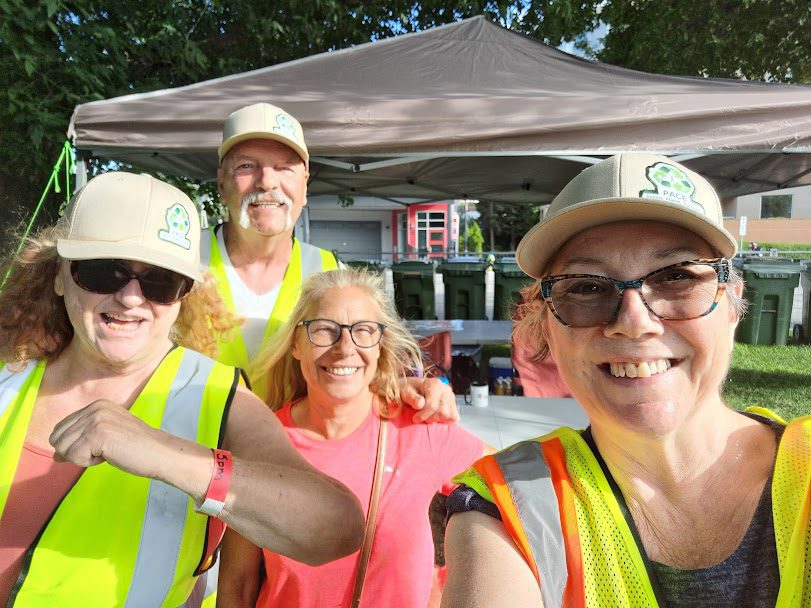
One very successful outcome was a pilot program with the City of Penticton to collect and sort food waste at major community events. The project created safer, less physical jobs that were ideal for workers who could not participate in more demanding contracts. It was well received by the City, event organizers and the public, and now we are now working with the City to expand the contract to include future seasonal and large-scale events.
We also began two new pilots with the Community Foundation of South Okanagan Similkameen to create a more centralized system for handling maintenance tasks such as parking lot cleaning, lawn care, and janitorial work. These contracts have the potential to provide a steady stream of year-round employment opportunities for marginalized workers.
What comes next?
While we did not reach the number of new contracts we had hoped to, the contracts we did realize provided new revenue streams that will help stabilize PACE’s social enterprise operations. With clear operational processes in place, our model can be expanded to contracts with any organization or business that is willing to participate, and our model can now be easily replicated in other communities. We welcome local businesses struggling to fill positions to reach out to PACE and learn more about the program.